Scaling upay's High-Throughput Golang Financial Gateway
Validating a single financial transaction required querying four downstream services sequentially, causing unacceptable API timeouts under peak load.
Achieved near-zero latency by parallelizing downstream lookups via Goroutines, and eliminated distributed database locks using the Saga pattern.
On this page
1. The Bottleneck: Sequential Latency Cascades in Financial Gateways
In a major Mobile Financial Service (MFS) like upay with millions of active wallets, financial transactions cannot afford sequential latency overhead. Peak traffic events (such as monthly salary disbursements and festival cash-outs) push gateway concurrency to thousands of requests per second, where every downstream network hop compounds into visible user lag and worker starvation.
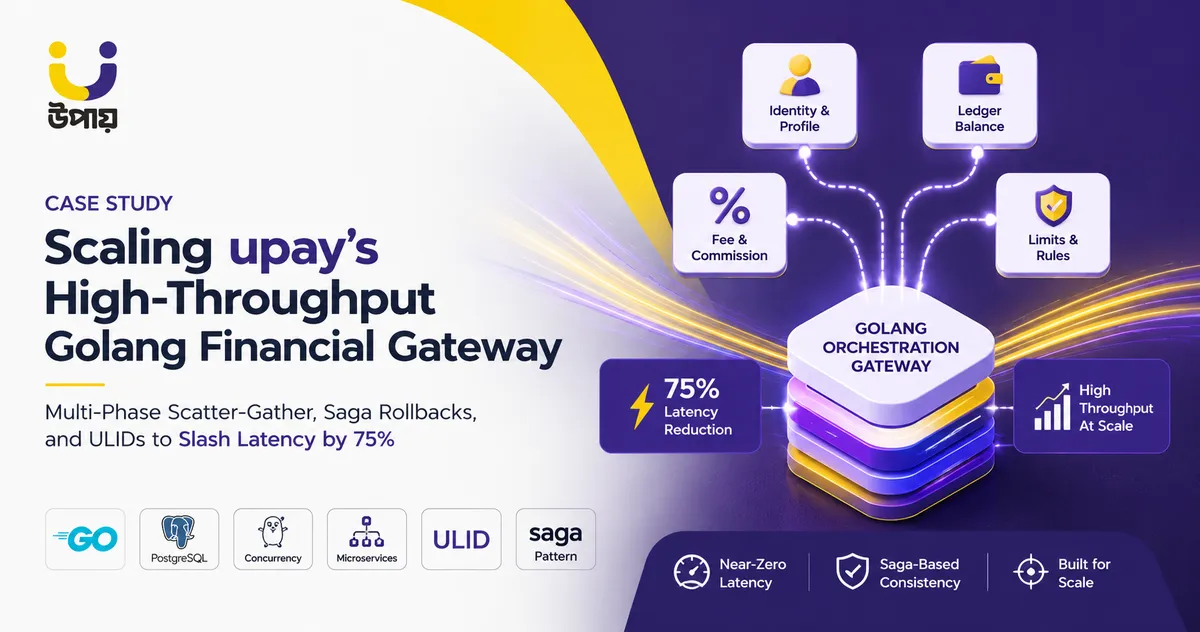
Whether a customer triggers a Peer-to-Peer transfer (Send Money), an agent Cash-In, or an ATM/Agent Cash-Out, the transaction engine cannot execute a simple atomic database deduction. Instead, it must orchestrate across multiple isolated microservices:
- Identity & Profile Validation: Verifying sender/receiver KYC, account status, and remitter blocks.
- Core Financial Ledger: Querying real-time ledger balances and tag-blocked funds.
- Fee & Commission Engine: Calculating dynamic tariffs, cash-out fees, and distributor commissions.
- Limits & Rules Engine: Enforcing daily, monthly, and per-transaction limits.
Executing these downstream API calls sequentially created a severe multi-hop latency cascade. At 50ms per network round-trip, the gateway lost 200ms+ before executing core business logic, resulting in worker starvation, database lock contention, and high API timeout rates under peak traffic.
To solve this bottleneck, I engineered a high-throughput orchestration gateway using Go’s concurrency primitives (Goroutines and Channels), multi-phase Scatter-Gather pipelines, and autonomous Saga Pattern compensation mechanisms.
2. Distributed Architecture: Multi-Phase Scatter-Gather Pipeline
To eliminate synchronous blocking without introducing race conditions, I restructured the gateway into a multi-phase pipeline. Downstream dependencies are split into non-dependent concurrent stages.
graph TD
    Client(["Mobile App / USSD"]) --> GW["API Gateway (Go Orchestration Layer)"]

    subgraph Phase 1: Foundational Checks
        GW --> S1{"Scatter"}
        S1 --> P1["Identity Verification"]
        S1 --> P2["Ledger Balance"]

        P1 --> G1{"Gather"}
        P2 --> G1
    end

    G1 -->|"Fail"| Drop["Fast-Fail Short Circuit"]
    G1 -->|"Pass"| S2

    subgraph Phase 2: Business Logic & Limits
        S2{"Scatter"} --> L1["Policy & Limits Service"]
        S2 --> L2["Txn Eligibility Engine"]

        L1 --> G2{"Gather"}
        L2 --> G2
    end

    G2 -->|"Fail"| Drop
    G2 -->|"Pass"| StatefulCommit["Transaction Execution (Ledger Finalize)"]

    StatefulCommit -->|"Commit Success"| AsyncPost["Concurrent Post-Processing (History Sync & SMS)"]
    StatefulCommit -->|"Commit Failure / DB Fail"| Compensation["Saga Compensation (Limit Reversal)"]
Why Standard Synchronous Architectures & Distributed Locks Failed
- Cascading I/O Delays: Sequential microservice calls accumulated network latencies additively.
- Why Not Distributed Locks (Redis / 2PC)? I evaluated Redis-based distributed mutexes (Redlock) and Two-Phase Commit (2PC). Under peak load, distributed locks introduced severe network round-trip overhead and single-point lock contention. 2PC held database transactions open across network boundaries, exhausting PostgreSQL connection pools.
- Fast-Fail Short-Circuiting: By separating foundational read queries (Phase 1) from state-modifying limit checks (Phase 2), invalid transactions drop before incurring costly database operations.
3. Core Implementation: Go Concurrency, Saga Compensation & ULIDs
3.1 Multi-Phase Scatter-Gather Pipeline
Using Go’s native channels and Goroutines, the gateway scatters Phase 1 calls simultaneously, gathers responses, and short-circuits instantly on failure.
// Phase 1: Fetch core foundational data concurrently
profileChan, profileErrChan := make(chan []Profile), make(chan error)
go services.FetchUserProfiles(profileChan, profileErrChan, userIDs)

balanceChan, balanceErrChan := make(chan *LedgerBalance), make(chan error)
go services.FetchLedgerBalance(balanceChan, balanceErrChan, senderID)

// Gather Phase 1: Fast-Fail Short-Circuit
profiles, profileErr := <-profileChan, <-profileErrChan
balance, balanceErr := <-balanceChan, <-balanceErrChan

if profileErr != nil || balanceErr != nil {
    return respondWithError("Foundational validation failed")
}

// Phase 2: Scatter limit reservation and eligibility checks concurrently
limitChan, limitErrChan := make(chan bool), make(chan error)
go services.VerifyTransactionLimits(limitChan, limitErrChan, senderID, amount)

eligibilityChan, eligibilityErrChan := make(chan bool), make(chan error)
go services.CheckTxnEligibility(eligibilityChan, eligibilityErrChan, profiles, amount)

// Gather Phase 2
limitPassed, limitErr := <-limitChan, <-limitErrChan
isEligible, eligibilityErr := <-eligibilityChan, <-eligibilityErrChan

if limitErr != nil || eligibilityErr != nil || !limitPassed || !isEligible {
    return respondWithError("Transaction limits or eligibility check failed")
}
3.2 Eliminating Distributed Database Locks with the Saga Pattern
In a distributed financial system, two-phase commits (2PC) introduce severe performance bottlenecks. I adopted eventual consistency via explicit Saga Compensation.
When limits are updated upstream, if the final ledger Finalize step fails or local PostgreSQL initialization fails, the gateway executes an autonomous limit reversal:
// Finalize transaction in the Core Financial Ledger
ledgerRes, err := ledgerClient.FinalizeTransaction(ctx, txnTokens)

// If final commit fails, execute Saga Compensation (Limit Reversal)
if err != nil || ledgerRes.HasError() {
    // Saga Compensation: Revert reserved limit upstream
    repositories.RevertUserTransactionLimits(senderID, amount)

    // Update local DB transaction record to failed status
    repositories.UpdateTransactionStatus(db, txnID, StatusFailed)

    // Concurrent failure notification
    notificationErrChan := make(chan error)
    go notifications.SendFailureAlert(notificationErrChan, senderID, txnID)

    return response.TransactionFailed()
}
3.3 Database Survival: Connection Pool Tuning & ULID Primary Keys
High write throughput under peak traffic can cause B-Tree index fragmentation when standard UUIDv4s are used. Furthermore, unmanaged connection creation quickly exhausts PostgreSQL connection pools.
- Dynamic Connection Pooling Configuration:
// Tune sql.DB connection limits via Viper environment configuration
sqlDb.SetMaxIdleConns(viper.GetInt("SET_MAX_IDLE_CONNECTIONS"))
sqlDb.SetMaxOpenConns(viper.GetInt("SET_MAX_OPEN_CONNECTIONS"))
sqlDb.SetConnMaxIdleTime(viper.GetDuration("SET_CONNECTION_MAX_IDLE_TIME"))
sqlDb.SetConnMaxLifetime(viper.GetDuration("SET_CONNECTION_MAX_LIFE_TIME"))- ULID Identifiers over UUIDv4:
// Generate time-monotonic, lexicographically sortable identifiers
trxId := utils.NewUlidString()
batchId := utils.NewUlidString()
Because ULIDs (Universally Unique Lexicographically Sortable Identifiers) append 48-bit timestamps to the front of the identifier, insert operations hit sequential B-Tree leaf pages in PostgreSQL, preventing index fragmentation and maintaining flat write latencies.
3.4 Concurrent Post-Processing Synchronization
After the core transaction is finalized in the core ledger, post-processing tasks (transaction history sync and multi-channel SMS/push alerts) are executed in parallel Goroutines. The gateway gathers channel completion statuses before returning the HTTP response:
// Concurrent post-processing execution
historySyncChan := make(chan *TransactionRecord)
go syncs.UpdateLedgerHistoryAsync(db, historySyncChan, txnID, amount)

notificationErrChan := make(chan error)
go notifications.SendSuccessAlert(notificationErrChan, senderID, receiverID, amount)

// Gather async task completion
notificationErr, historyRecord := <-notificationErrChan, <-historySyncChan
4. Production Benchmarks: 75% Latency Drop & Lock Elimination
Deploying this multi-phase concurrent gateway in Golang eliminated the sequential I/O bottleneck across downstream microservices under peak load.
Production Performance Comparison
| Metric | Legacy Synchronous Flow | Concurrent Go Gateway | Improvement |
|---|---|---|---|
| End-to-End Latency | 900 ms - 1,500 ms (1.5s) | 300 ms - 400 ms | ~70%-75% Reduction |
| PostgreSQL Index Bloat | High (B-Tree splits via UUIDv4) | Near-Zero (ULID Sequential Inserts) | Flat I/O Profile |
| API Timeout Rate | Frequent during peak disbursements | Near-Zero Timeouts | Near 100% Reliability |
Architectural Invariants & Key Takeaways
- Multi-Phase Scatter-Gather: Group downstream queries into dependent phases. Scatter independent lookups early to cut overall response time to
max(Stage_Latency)instead ofsum(Stage_Latency). - Embrace Saga Compensation over Distributed Locks: Distributed locks (like Redis locks or 2PC) bottleneck throughput. Use local state machines with compensating rollback functions for eventual consistency.
- Use ULIDs for High-Write Primary Keys: For append-heavy financial tables in PostgreSQL, ULIDs preserve B-Tree index cache locality and prevent expensive random page splits.
Did this teardown help you?
Tap an emoji to react · Claps enabled up to 20×

Enjoyed this? I write about backend systems and architecture — rarely, but always substantive.